Monday, March 26, 2012

Modernizing the XY Controller with a 3rd Turtle

Last week I discussed the application specific space saving application of the XY controller.  When having to modernize these, not only do we have to work with the specific constraints of the hardware - [see last weeks post] - but also the fact that at the same time, we might have to jump 40 years in technology.

In this post I extend the conjectured modernization by considering the modernization of an 20th century item of plant control to the 21st century use of lets say semantic technology.  For this example being substation oriented, we should consider going from the Master Slave relay logic direct to it's representation as an IEC 61850 object publication and control. This is not a post about IEC 61850 specifically, but uses that new technology to illustrate the point relating to modernization and re-integration of older technology into the new semantic type technology.

If you have read this far, you might want to know why does that matter ?  I will try to keep to the point in less than 600 words, and the graphic may help, but please read to the end, think for a few minutes and make any comment about modernization you feel relevant.

Monday, March 19, 2012

The Space Saving XY Controller

XY Controller Decoding Matrix
I recently had to revisit an older control application, where the customer wanted to keep everything the same, but replace his older remote terminal unit technology with perhaps a newer one, yet keep the existing wiring and functionality. With some of the older equipment the limitations of space, both physical, and in terms of protocol address space, meant that engineering remote control solutions often meant optimization of space at the expense of urgency and time. The challenge in modernization almost always starts with No change in SPACE, no change in WIRING, and ends in trying to exchange modern high tech equipment into the same cabinets and racks which the older equipment occupies.

Monday, March 12, 2012

Operational Metasystem Transitions

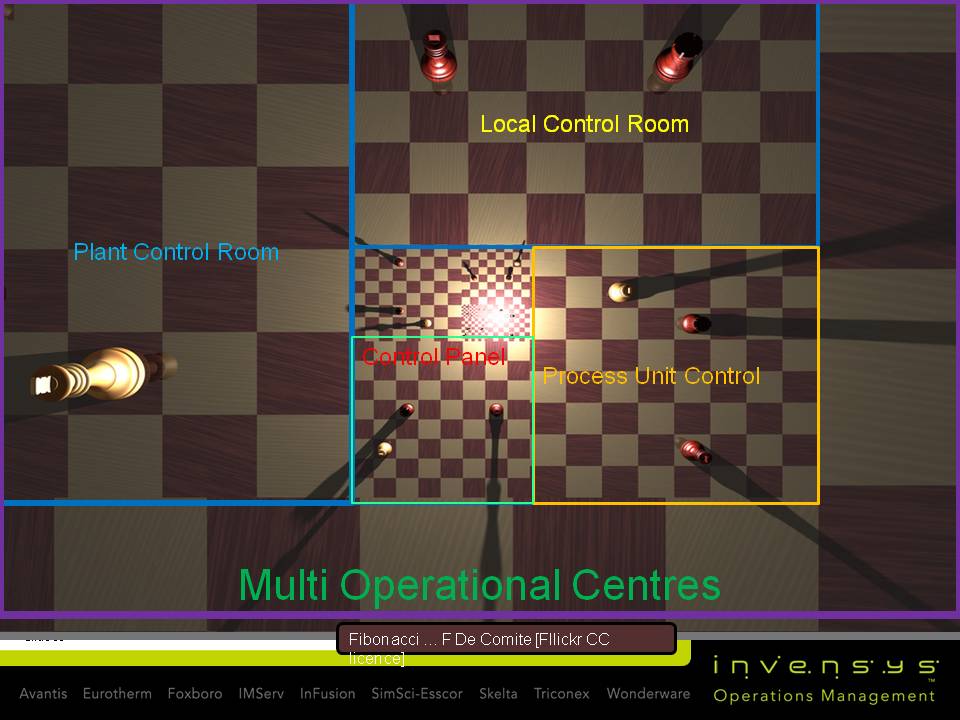
A view of the operational spaces
In my last post we saw the influence of the rapid rise of AI on playing chess, and you might have drawn the connection with online chess games, now using the AI engines for online chess playing.
In this blog post I segment the operational space into a convenient metasystem 'model' to first define a set of operational levels and then layout so of their features and attributes.


Tuesday, March 6, 2012

Control Systems beyond Deep Blue

It's only Human 
my faithful Machine Interface
to want to move to a more collaborative scene
I've seen 'a space odyssey' and it's memorable dream
where HAL the ship computer didn't know what we need


and we are beyond the time of Deep Blue


Now, it's our collective tactical crush
which makes us take hold of a wii
and swing it around
in total control
virtually


We are entering a phase where the HMI will become somewhat subservient in ways we don't yet understand to a higher level of computational interaction. This month we explore on this blog, aspects of the Operational Interface, and the transition to more collaborative technology.

Monday, February 27, 2012

SCADA is Elephants and Turtles all the way down


We had just moved some of our SCADA engineering to the Invensys facility in West Durrington, Worthing, UK. Worthing is down by the beach not far west of Brighton on the English channel. Not far from Worthing, if you go up past Arundel, is Goodwood, the home of the famous racing circuit among other things.  I found the Cass Sculpture park there and wandering around on a weekend. I stumbled across Tony Cragg's public sculpture. I like this one in particular for it's topology, and for today's post I think it relevant in the discussion on the general form of SCADA systems. This post includes a Turchin style dialog on SCADA, what is it and what does it mean. It also includes a general discussion on metasystems and holons and how SCADA architectures themselves include aspect of these higher level concepts.  So if you are brave... read on...


Tuesday, February 21, 2012

Engineering the Semantic Plant


Engineering complex close fitting encapsulated control systems for plants requires the incorporation of a number of data capture and review processes to eliminate the post start up operational risk as early as possible in the project time frame.

While the 'semantic web' continues to take shape with SPARQL and RDP/OWL databases and their definition taking shape in ISO 15926 construction communities, Invensys is building up the core tools, templates, rules bases and workbench processes to take on larger and larger plant designs in collaboration with it's customers.


Reflected Doyle Spirals - F Decomite [Flickr] [ CC ]
The Doyle Spiral as depicted in Reflected Doyle Spirals beautifully traces the packing of ever increasing circle size in sets of interlocking coloured spirals. These sets have aspects of encapsulation, increasing scale, close fitting components and simple recursive rules to define their behaviour. It is my view that engineering highly scalar control and safety systems follows similar structures, and as such, we might keep in mind how best to frame the close fitting data exchanges between different companies and engineering teams in order to make them equally elegant.


Tuesday, February 14, 2012

Universal IO - Then end of the Marshalling Panel

Ever since the ability to quickly compute and the creation of electronic configurations, we've seen companies struggle with trying to quickly develop consistent configurations from a top down logical design basis.  The advent of object oriented systems has enabled configuration to be partitioned in uniquely named environments.  If only the real world would comply with the lovely abstract designs we have on the computer screen.


Popular Posts